

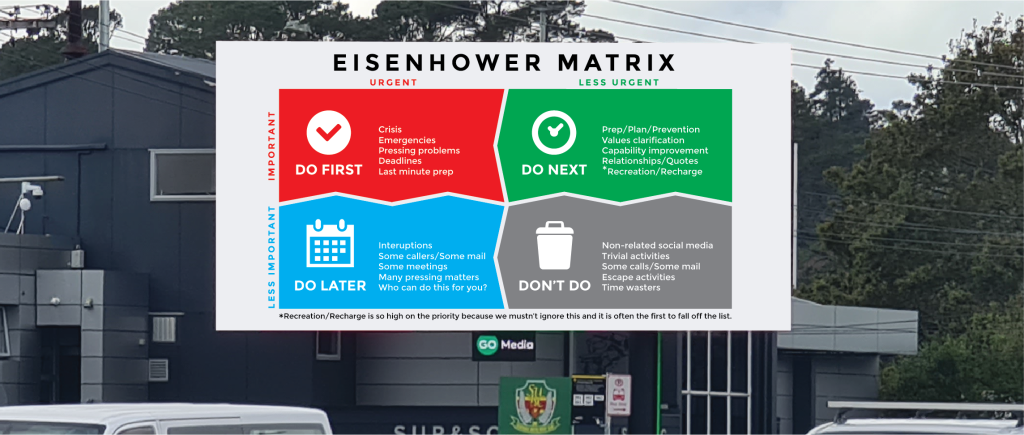
It’s Monday morning and you’re faced with a list of things to do, but mindful of balancing ‘working on the business’ vs ‘in the business’. How do you decide how much time to spend on things like marketing, networking, improvement, new technology (e.g.: AI), new products, etc?
How do we know where to start and when to set aside time? When time allows, or more structured?
Tackling this challenge might be separated into 2 very different tiers:
1. Make a list of tasks so you can prioritise them. (Googling ‘Business Prioritising’ you would likely land on this first tier).
Just a list, no particular order. An ongoing list you keep adding to. You will likely add more to the list than you may ever tick off. Then plot them on this ‘Eisenhower Matrix’ above.
2. Take control of your own list. (This second tier is what can make this fun).
The second and more important tier to dig into, taking a broader and more realistic look at this, you can work out what you do first out of the highest priorities, and understand when it is OK to wander from the plan.
Apply this thinking to control your list:
• Make your task list.
• Plot the tasks on a matrix to establish priorities.
• Plan when you do your best work. Understand what times of the day and week you do your best creative and productive work. There is little point flogging yourself to tackle the most challenging stuff when you are not going to be productive. Maybe give this type of categorising a go – 3 hats: Marketing, Operations, Relationships.
• Know your strengths. Be very clear about what you must do yourself, and what you can delegate or give to an expert to do it better.
• Calendarise so you lock in time slots. Set times frames.
• Be disciplined. Sometimes it just takes you to make a start.
• Commit. Publicly announce your intentions if it is relevant. E.g.: if you are posting about something new such as ‘watch this space’, set a specific deadline. This will help you remain accountable.
• Step outside your comfort zone at least once a day – The brain is a muscle, you will find you become more comfortable being uncomfortable.
• Know when it is okay to deviate. If you are disciplined most of the time, it’s okay to do something you feel like doing as a treat. But watch this.
If you have a clear purpose lead by a Vision (E.g.: Every one of our products enhances people’s lives) and followed through by a Mission (E.g.: Customer research leads our product development), then you may find even the hard stuff is the fun stuff.